
Iron deficiency is not a niche diagnosis, and it is not evenly distributed. The World Health Organization estimates anaemia affects roughly half a billion women aged 15 to 49 worldwide, along with 269 million children aged 6 to 59 months. In 2019, 30% of non-pregnant women and 37% of pregnant women in that age band were affected.
Most of that anaemia traces back to iron. The WHO calls iron deficiency, driven mainly by inadequate dietary intake, the most common nutritional deficiency behind anaemia. So when a Global Burden of Disease analysis published in Annals of Medicine in August looked at where dietary iron deficiency concentrates, it was describing something already familiar to public health researchers — and still stubbornly unresolved.
What the burden numbers actually say
The analysis, using GBD 2021 data across 204 countries, found that dietary iron deficiency falls hardest on women aged 20 to 54, with the greatest concentration in low- and middle-income countries and the highest burden in South Asia among the 21 GBD regions.
Globally, the age-standardized disability-adjusted life year rate was 423.74 per 100,000 in 2021 (95% uncertainty interval 285.27 to 610.83), down from 517.98 in 1990. That looks like progress, and in rate terms it is. But the same paper notes that global prevalence of iron deficiency rose from 1.50 billion cases in 1990 (28.2%) to 1.92 billion in 2021 (24.3%) — a smaller share of a much larger population. Absolute case counts went up, not down.
The country picture is uneven. China’s age-standardized rate fell from 285.82 in 1990 to 115.30 in 2021. India’s burden increased among younger age groups; the estimated annual percentage change for DALY rates in infants under one was 0.36 (95% CI 0.30 to 0.41). A separate Annals of Medicine meta-analysis of 45 Indian studies covering 159,979 adolescents put pooled nutritional anaemia prevalence at 56% (95% CI 49% to 63%), with higher rates in girls (62%) than boys (39%).
These are modelled estimates built on survey and surveillance data, not a census of blood tests. They are the best available map of a problem, not a diagnosis for anyone reading this.
Where the United States sits
American data tell a narrower version of the same story. CDC’s National Center for Health Statistics puts anaemia prevalence at 13.0% of females aged 2 and older, against 5.5% of males, based on August 2021 to August 2023 data. Iron deficiency in children aged 1 to 2 measured 22.5% in the 2017 to March 2020 cycle, using an inflammation-adjusted serum ferritin threshold below 15 µg/L.
The Office on Women’s Health, part of the U.S. Department of Health and Human Services, frames the sex gap in practical terms: iron-deficiency anaemia affects more women than men, and the risk is highest during pregnancy — where it affects about one in six pregnant women — and among women with heavy menstrual periods, which account for up to 5% of cases in women of childbearing age.
That is worth sitting with. A nutrient gap that shows up in roughly one in eight American females is not a rare finding, and it is not confined to people who eat badly. The OWH notes that most people in the United States do get enough iron from food.
Why it is easy to miss
Iron-deficiency anaemia develops slowly. Early on there may be no symptoms at all, or symptoms mild enough to attribute to a busy month. As it progresses, the OWH list includes fatigue and weakness as very common, along with dizziness, headaches, low body temperature, pale or yellow “sallow” skin, a rapid or irregular heartbeat, breathlessness or chest pain with activity, and brittle nails.
Two entries on that list are less familiar. One is pica — unusual cravings for ice, very cold drinks, or non-food items such as dirt or paper. The other is that fatigue and breathlessness on exertion are also the two symptoms the WHO leads with, and both are thoroughly non-specific. Nothing about feeling tired identifies iron as the cause; a dozen other things produce the same complaint.
The test comes before the bottle
This is the part the supplement aisle tends to skip. The OWH is direct: if you think you may have iron-deficiency anaemia, talk to a doctor or nurse, and do not take iron pills without talking to them first.
Diagnosis starts with a complete blood count. If the count shows anaemia, the OWH says a further blood test measuring iron levels is likely, and then — this is the step that matters — the clinician looks for why. Bleeding is a common route: heavy or prolonged periods, uterine fibroids, digestive problems such as ulcers or colon polyps, long-term aspirin or over-the-counter pain reliever use, or donating blood too often. Absorption problems from Crohn’s disease, coeliac disease or gastric bypass produce the same picture from the other direction.
A haemoglobin number on its own does not separate iron deficiency from other causes of anaemia, and it does not explain the cause. Treating the number without finding the reason can leave the reason running.
What the supplement aisle can and cannot do
When a clinician does recommend iron, the OWH’s practical guidance is specific: start with half the recommended dose and build up, split the dose across the day rather than taking it all at once, take it with food — ideally something containing vitamin C — and ask for a different preparation if one causes trouble. Upset stomach, constipation and diarrhoea are the common side effects; liquid iron can stain teeth.
There is also a newer, more speculative signal about dose. A cross-sectional NHANES analysis published in the Asia Pacific Journal of Clinical Nutrition in September looked at 13,284 U.S. adults and three algorithms that estimate “biological age” from routine clinical biomarkers. Dietary iron intake was associated with younger biological age, while supplemental iron above 18 mg per day was associated with accelerated biological ageing; serum iron showed a U- or J-shaped relationship, with the favourable band around 15.2 to 18.8 µmol/L.
Read that carefully before drawing conclusions. It is one cross-sectional survey, so the direction of cause is unknown — people who are unwell may take supplements, and people who eat well differ from people who do not in dozens of ways the models cannot fully adjust for. Biological age algorithms are surrogates, not outcomes anyone experiences. Intake came from 24-hour dietary recalls. And 18 mg is not an exotic dose: it is the recommended daily iron intake for women aged 19 to 50 in the OWH’s own table, which is exactly why the finding is interesting rather than dismissible — it hints at a ceiling near ordinary recommendations, not a case for megadoses.
For readers weighing plant-based eating, the B12 piece we published on the plant-based nutrient gap covers the parallel question of a nutrient that is harder to get from plants. Iron is not in the same category, but the same discipline applies: measure before supplementing.
Food first, with an absorption asterisk
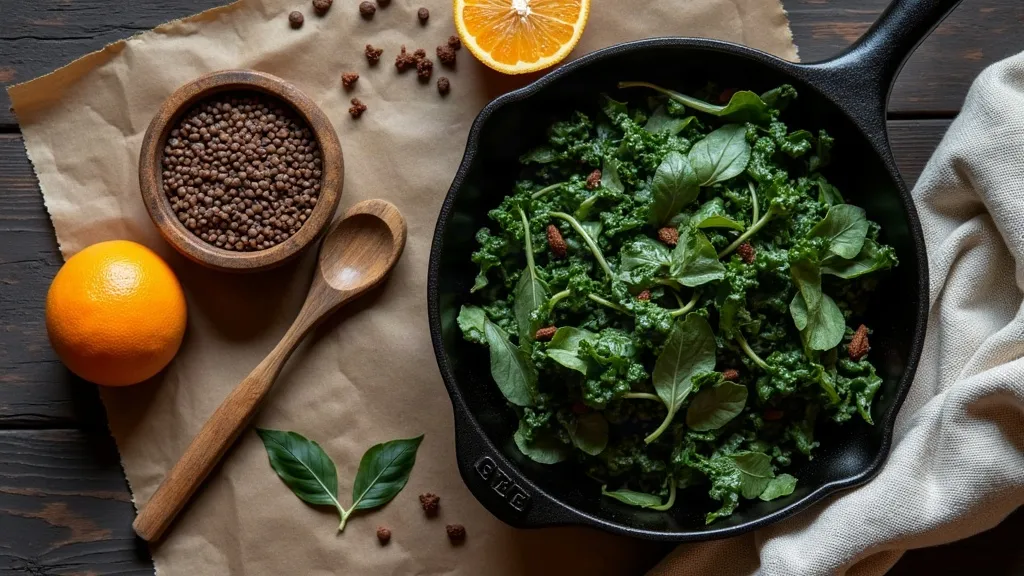
The WHO’s dietary advice is blunt about mechanics. Iron-rich foods include lean red meat, fish and poultry, legumes such as lentils and beans, fortified cereals, and dark green leafy vegetables. Vitamin C-rich fruits and vegetables help the body absorb iron. And several ordinary foods work against it when eaten at the same time: bran in wholewheat flour and oats, tea, coffee, cocoa, and calcium. If calcium and iron supplements are both on the schedule, the WHO suggests taking them at different points in the day.
The OWH adds the heme detail that explains a lot of confusing dietary advice: iron from animal foods such as meat, chicken and fish is absorbed two to three times better than iron from plant foods. Vegetarians and vegans therefore need to choose iron sources deliberately, and pairing plant iron with vitamin C helps. The OWH’s intake table sets the daily figure at 18 mg for women aged 19 to 50, 27 mg during pregnancy, 8 mg from age 51, and 32 mg for vegetarian women aged 19 to 50 — the higher plant-food figure reflects that absorption difference, not a different requirement.
If vegetables are the weak point in the plate, our guide to the signs you are not eating enough vegetables covers the practical side of that.
What we did not find
No trial evidence that iron supplements relieve fatigue in people who are iron-replete. No national screening programme for iron deficiency in asymptomatic adults. No dietary pattern that reliably fixes heavy menstrual bleeding. And no sign that the World Health Assembly’s target of halving anaemia in women of reproductive age by 2030 is on track, which is the honest reading of a burden that shrank in percentage terms while growing in absolute numbers.
Iron deficiency is common, it is treatable, and the treatment depends entirely on which of several causes is producing it. That is a conversation to have with a clinician, along with the blood tests that make it concrete — not a decision to make from a symptom checklist. Our medical disclaimer sets out the limits of what an article like this can do.