
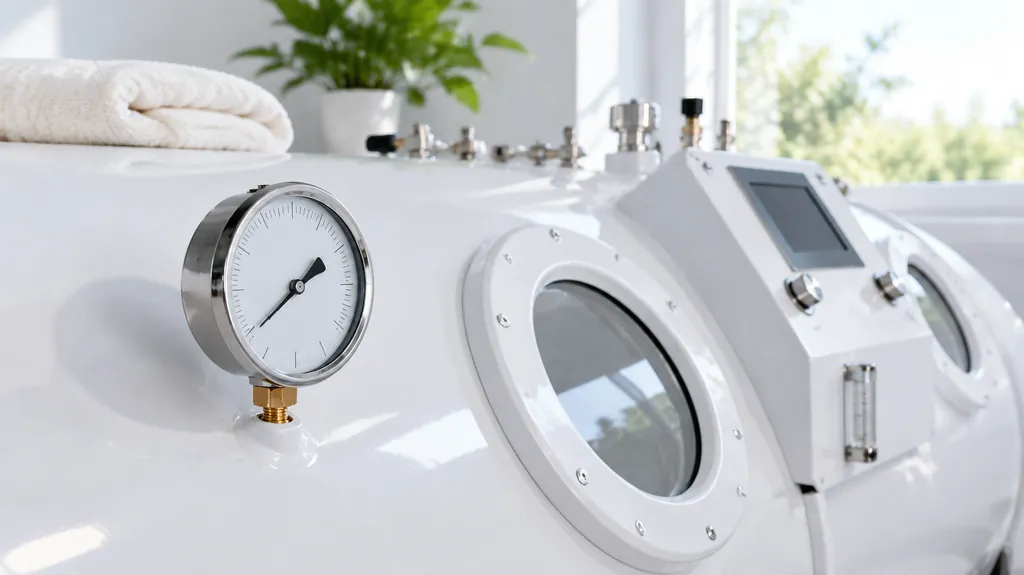
Every listing for a home hyperbaric chamber leads with the same figure. 1.3 ATA. 1.5 ATA. 2.0 ATA. It sits next to the price, it drives the price, and it is usually the only technical number a buyer is shown before the checkout page. Between the cheapest inflatable bag and a clinical steel chamber, the price can rise roughly tenfold, and most of that gap is paying for pressure.
So it is worth knowing what the number measures, what regulators have and have not said about each level, and what changes in practice when a seller moves you from 1.3 to 2.0. We went through FDA filings, the Undersea & Hyperbaric Medical Society (UHMS) position statement and several manufacturers’ spec pages.
What “ATA” measures
ATA stands for atmospheres absolute: the total pressure inside the chamber, counting the one atmosphere we already live under at sea level. 1.0 ATA is the room you are sitting in. 2.0 ATA is double that, the same pressure a diver feels about 33 feet (10 metres) under seawater. 1.3 ATA corresponds to roughly 10 feet down, and 3.0 ATA to about 66 feet.
Manufacturers also quote pressure in psi, which counts only the pressure above the room. Newtowne lists its soft chambers as “4 psi / 1.3 ATA”; OxyHealth describes its Vitaeris 320 the same way. To convert, add 14.7 and divide by 14.7.
Reading a spec sheet: the same pressure in four units
Spec sheets mix units freely, and a chamber listed at “4.4 psi” can look like a different product from one listed at “1.3 ATA” when they are the same thing. Our conversion, rounded (gauge psi is pressure above the room; kPa here is absolute; depth is the seawater equivalent):
| ATA | psi (gauge) | kPa (absolute) | Seawater depth |
|---|---|---|---|
| 1.0 | 0 | 101 | Surface |
| 1.3 | 4.4 | 132 | about 10 ft (3 m) |
| 1.5 | 7.3 | 152 | about 16 ft (5 m) |
| 1.7 | 10.3 | 172 | about 23 ft (7 m) |
| 2.0 | 14.7 | 203 | about 33 ft (10 m) |
| 2.4 | 20.6 | 243 | about 46 ft (14 m) |
| 3.0 | 29.4 | 304 | about 66 ft (20 m) |
The soft chambers in the FDA files are set by relief valves at 4 psi, which is strictly about 1.27 ATA; the industry rounds it to 1.3. The useful habit is to ask whether any figure on a listing is gauge or absolute before comparing two chambers.
The reason pressure matters is oxygen. The amount of oxygen your lungs see depends on two things multiplied together: the pressure, and the share of oxygen in what you breathe. That second variable is where much of the marketing goes quiet.
The arithmetic sellers rarely print
Here is a simplified calculation of the oxygen partial pressure a person breathes (it ignores water vapour and mask leaks, so treat it as approximate):
- Room air at sea level: 1.0 ATA × 21% oxygen = 0.21
- Soft chamber at 1.3 ATA, breathing chamber air: 1.3 × 21% = 0.27
- Plain oxygen mask at sea level, no chamber at all: 1.0 × ~100% = about 1.0
- Hard chamber at 2.0 ATA, oxygen at ~93–95% by mask: about 1.9
- Hospital monoplace at 2.4 ATA, 100% oxygen: 2.4
The second line is the one to notice. A 1.3 ATA bag filled with ordinary air raises oxygen exposure by about a quarter. A mask at sea level raises it nearly fivefold. That is why the UHMS position statement on fabric chambers says mild hyperbaric exposures with air “deliver no more oxygen to the body than breathing oxygen by mask at sea-level pressure.”
The pressure number, in other words, is only half of the spec. A chamber’s oxygen source is the other half.
What the FDA has actually cleared
Under federal rules, a hyperbaric chamber is a Class II medical device, defined as one that raises environmental oxygen pressure to move oxygen into a patient’s tissue. Devices reach the market through the 510(k) process, by showing equivalence to an earlier device. What each device is cleared for is written into its file.
For soft chambers, that file is short. The 510(k) summary for Summit to Sea’s Dive series names the Gamow bag, the portable altitude-sickness bag used by mountaineers, as its predicate device. Its indication for use is one line: acute altitude sickness, “as prescribed by or under the direction of a physician.” The document describes the chambers as inflated with atmospheric air by a small electric pump, with relief valves set at 3.9 and 4 psi, which works out to 1.3 ATA. The UHMS statement summarises the category the same way: low-pressure fabric chambers operating below 1.4 ATA hold FDA clearance for acute mountain sickness only, are designed to be compressed with air, and FDA rules do not permit their use with supplemental oxygen.
Two things follow for a buyer. First, any soft chamber marketed for recovery, sleep, skin or anything other than altitude sickness is being sold off-label. Second, even the soft chambers carry a prescription indication. Newtowne’s own site says its mild chambers “require a prescription from a qualified medical professional for human medical use,” and lists the concentrator it sells as an accessory as prescription-only too.
Hard-shell and clinical chambers sit under the same device regulation, but with a much longer clinical history. The FDA’s 510(k) file for the Sechrist 3300H and 3600H, two of the most common hospital monoplace chambers, describes chambers “designed to administer 100% oxygen” at up to 3 ATA, and notes that typical monoplace units can pressurise to that level. On the clinical side, the UHMS list of approved indications covers conditions such as decompression sickness, carbon monoxide poisoning and certain non-healing wounds. Per the UHMS statement, all of those indications require near-100% oxygen at a minimum of 2 ATA. Wellness, recovery and general energy claims are not on the list at any pressure.
The three classes, by pressure
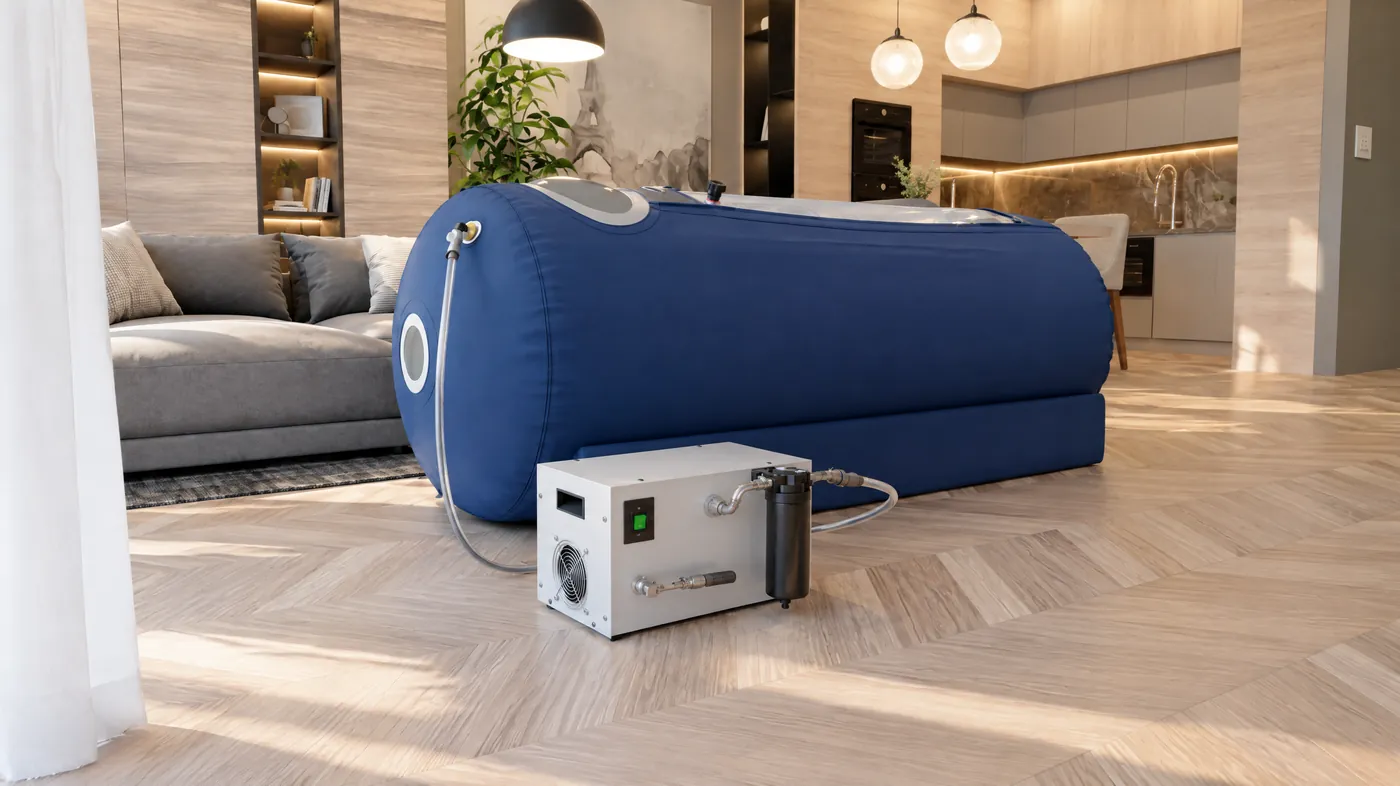
Soft-shell, 1.3 to 1.5 ATA. Inflatable fabric tubes or upright “tent” shapes, pressurised by a compressor. Cheapest, lightest, easiest to fit in a spare room. The FDA-cleared models top out at 1.3 ATA. A few newer soft-shell units are rated to 1.5 ATA; if you are looking at one, ask the seller which clearance and which pressure-vessel standard cover that higher rating, because the 510(k) files we read were written for chambers under 1.4 ATA.
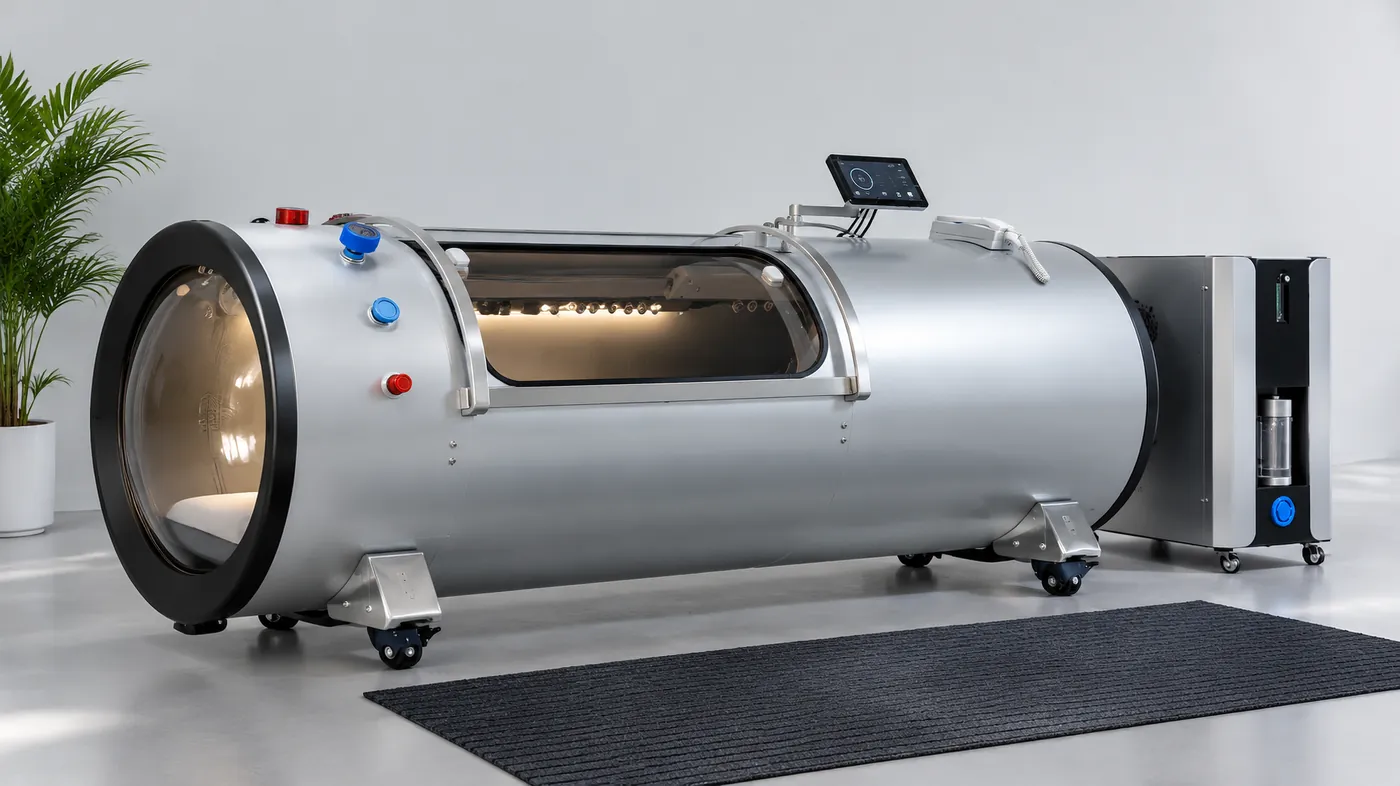
Hard-shell, 2.0 ATA. Steel, aluminium or polycarbonate vessels with a door rather than a zip, usually paired with a cabinet holding an air compressor and an oxygen concentrator. This is where home and clinic-grade wellness chambers have moved over the past few years, because 2.0 ATA is the floor the UHMS uses for its approved indications.
Hospital and clinical, 2.4 to 3.0 ATA. Monoplace chambers pressurised with pure oxygen, or larger multiplace rooms where patients breathe oxygen by hood or mask. Built to the hospital codes (in the US, the NFPA 99 Health Care Facilities Code governs how these facilities are built and run), staffed, and prescribed. They are not consumer products, but they are the reference point consumer marketing borrows.
The in-between numbers: 1.5 and 1.7 ATA
The tidy three-band picture has been blurring. Sellers increasingly market 1.5 ATA as a “bridge” tier, and some hard-shell chambers let the operator pick a setting below their 2.0 ATA maximum. Superhuman’s L1 lists 1.3, 1.5 or 1.7 ATA as selectable; its T2 lists 1.5. Airvida sells a portable lying chamber rated at 1.5 ATA and hard-shell lying and seated chambers rated from 1.5 to 2.0 ATA. At the other end, RL Health markets a reinforced soft-shell model rated up to 2.0 ATA, and says plainly that the rating belongs to that model, not to flexible chambers in general.
Two consequences follow for a buyer. A “2.0 ATA chamber” tells you its ceiling, not the pressure your sessions will run at. And once a soft-shell product claims more than the 1.3 ATA the soft-chamber clearances describe, the paperwork behind that claim matters more than the shell material.
Representative models, by pressure
The table below uses figures from each manufacturer’s own pages or from FDA filings. We have left prices out except where the manufacturer publishes them directly, because dealer pricing for the other brands varies widely.
| Model | Class | Rated pressure | Oxygen as specified | Notes from the source |
|---|---|---|---|---|
| Summit to Sea Grand Dive | Soft-shell | 1.3 ATA (4 psi) | Inflated with air | 9 ft long, 40 in wide (FDA K072757); cleared for acute altitude sickness |
| OxyHealth Vitaeris 320 | Soft-shell | 1.3 ATA (4 psi) | Air compressor; concentrator optional | 32 in diameter; described by OxyHealth as FDA 510(k) cleared |
| Newtowne A4-34 | Soft-shell | 1.3 ATA (4 psi) | Oxygen kit with mask listed; concentrator Rx-only | 34 in × 95 in |
| Superhuman S1 | Soft-shell | 1.5 ATA | See manufacturer | One occupant; from $14,900 |
| Airvida Pro | Portable, lying | 1.5 ATA | See manufacturer | Airvida’s portable tier |
| Macy-Pan HP2202-90 | Hard-shell | 2.0 ATA | 10 L/min concentrator in combined unit | Stainless steel and polycarbonate; 87 × 35 × 35 in |
| Superhuman L1 | Hard-shell | 2.0 ATA (1.3, 1.5 or 1.7 selectable) | Cabin pressurised with air; oxygen by mask, BIBS optional | One occupant; from $49,900 |
| Superhuman T2 | Hard-shell, seated | 2.0 ATA (1.5 selectable) | Onboard concentrator to built-in breathing system, no tanks | Two seated; 6 ft 10 in × 5 ft 5 in footprint; from $99,900 |
| Airvida Elite | Hard-shell, seated | 1.5 to 2.0 ATA | See manufacturer | Sitting layout |
| OxyHealth Fortius 420 | Hard-shell, clinical | Up to 4.0 ATA (OxyHealth’s figure) | 100% oxygen via hood or built-in breathing system | Steel, 42 in interior; prescription required |
| Perry Baromedical Sigma 34 | Hospital monoplace | 3.0 ATA (30 psi) | Air/oxygen select option | 33.5 in interior |
| Sechrist 3300H | Hospital monoplace | 3.0 ATA | 100% oxygen (FDA K140559) | 32.5 in interior |
Summit to Sea homepage, screenshot taken October 2026.
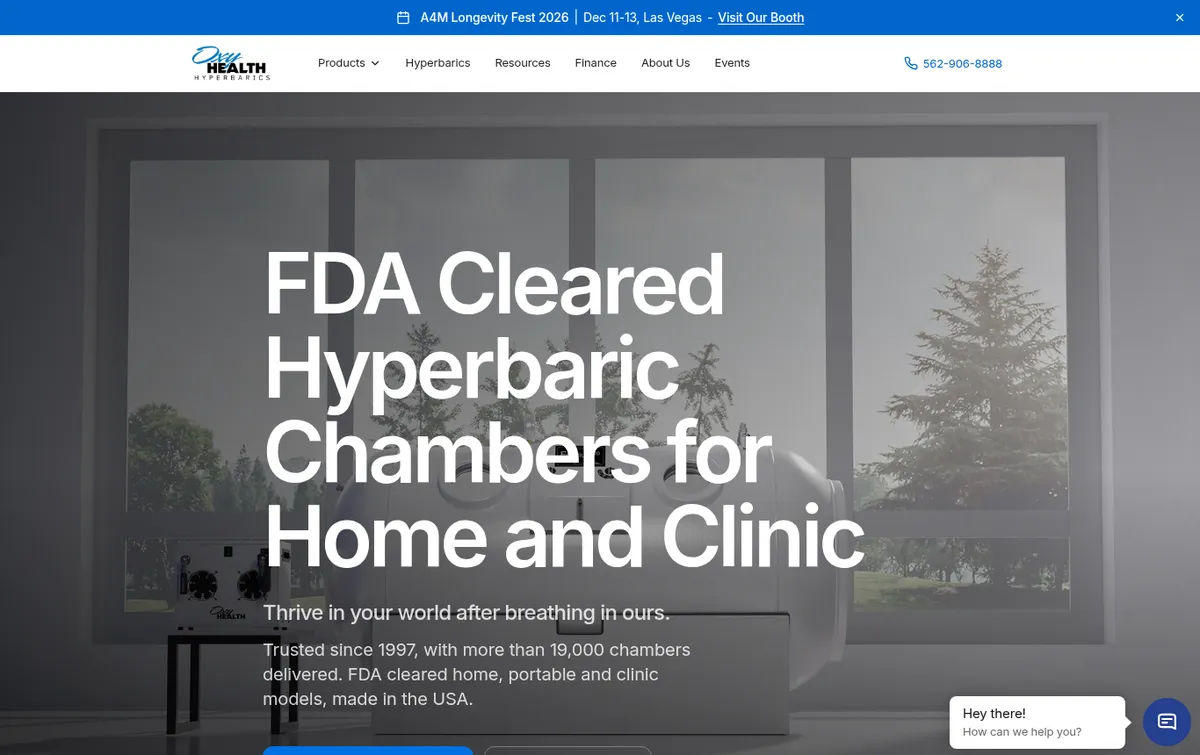
OxyHealth homepage, screenshot taken October 2026.
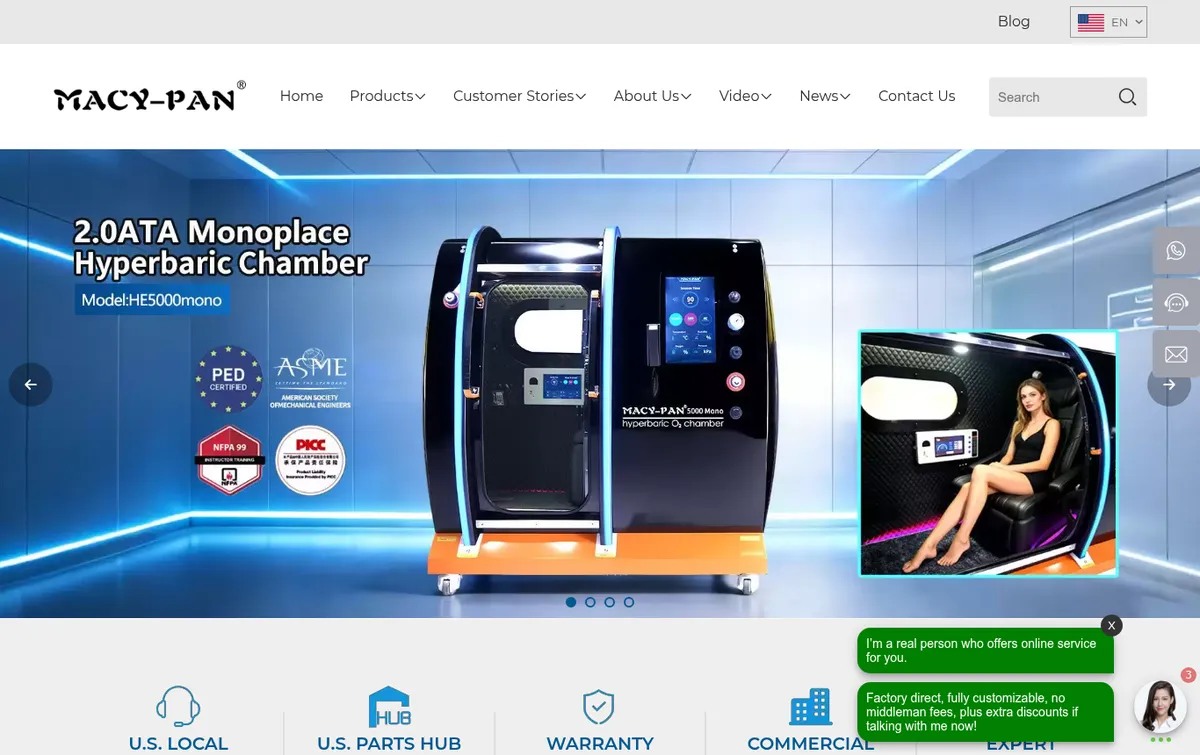
Macy-Pan homepage, screenshot taken October 2026.
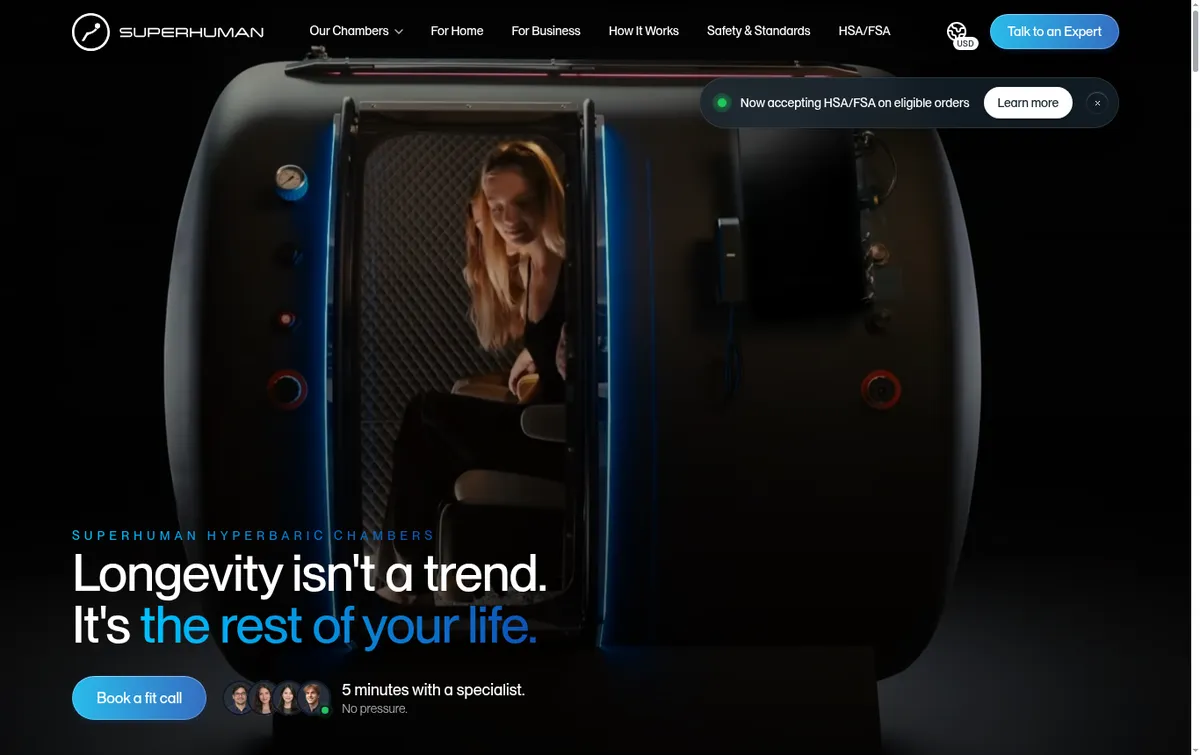
Superhuman homepage, screenshot taken October 2026.
Two patterns stand out. The soft-shell column clusters tightly at 1.3 ATA because that is what the clearances describe. And the hard-shell makers have converged on one design choice: pressurise the cabin with air and deliver oxygen to the face. Superhuman states it plainly on its T2 page (“the cabin is pressurized with air, never oxygen”), and OxyHealth specifies a hood or built-in breathing system for the Fortius 420. The hospital chambers are the exception, filling the whole vessel with oxygen under trained supervision.
For a longer manufacturer-side walk-through of how 1.3, 1.5 and 2.0 compare, Superhuman Chambers publishes a guide to ATA pressure in hyperbaric chambers; read it as a seller’s explanation, alongside the regulatory documents above.
Concentrator versus pure oxygen
The oxygen source is the line item that changes both the physiology and the risk.
An oxygen concentrator pulls nitrogen out of room air and delivers somewhere in the low-to-mid 90s percent oxygen at a fixed flow, typically 5 or 10 litres per minute in the units paired with chambers. It plugs into the wall, needs no deliveries, and is what nearly all home hard-shell systems use. In a soft chamber, a concentrator feeding a mask is the setup the UHMS says the FDA does not permit, even though concentrator kits are widely sold alongside them.
Medical-grade 100% oxygen, from bulk tanks or a hospital supply, is what monoplace hospital chambers run on. It reaches higher oxygen pressures, but it also concentrates the fire hazard. In an August 2025 letter to health care providers, the FDA reported recent chamber fires causing serious injuries and deaths, pointed to the “heightened risk of fire with use of oxygen at a high concentration,” and told operators to follow manufacturer instructions on clothing, grounding and banned items.
For a home buyer, an air-filled cabin with oxygen delivered by a sealed mask or built-in breathing system (BIBS, which vents exhaled breath outside the chamber) keeps the oxygen concentration in the room itself close to normal. That is a real safety difference, and it is worth more attention than the last 0.2 ATA. Hospitals draw the same line by chamber type: Mayo Clinic’s patient guide explains that a one-person monoplace is pressurised with pure oxygen, while in a multiplace room “the normal air in the room is pressurized” and each person breathes oxygen through a mask or hood.
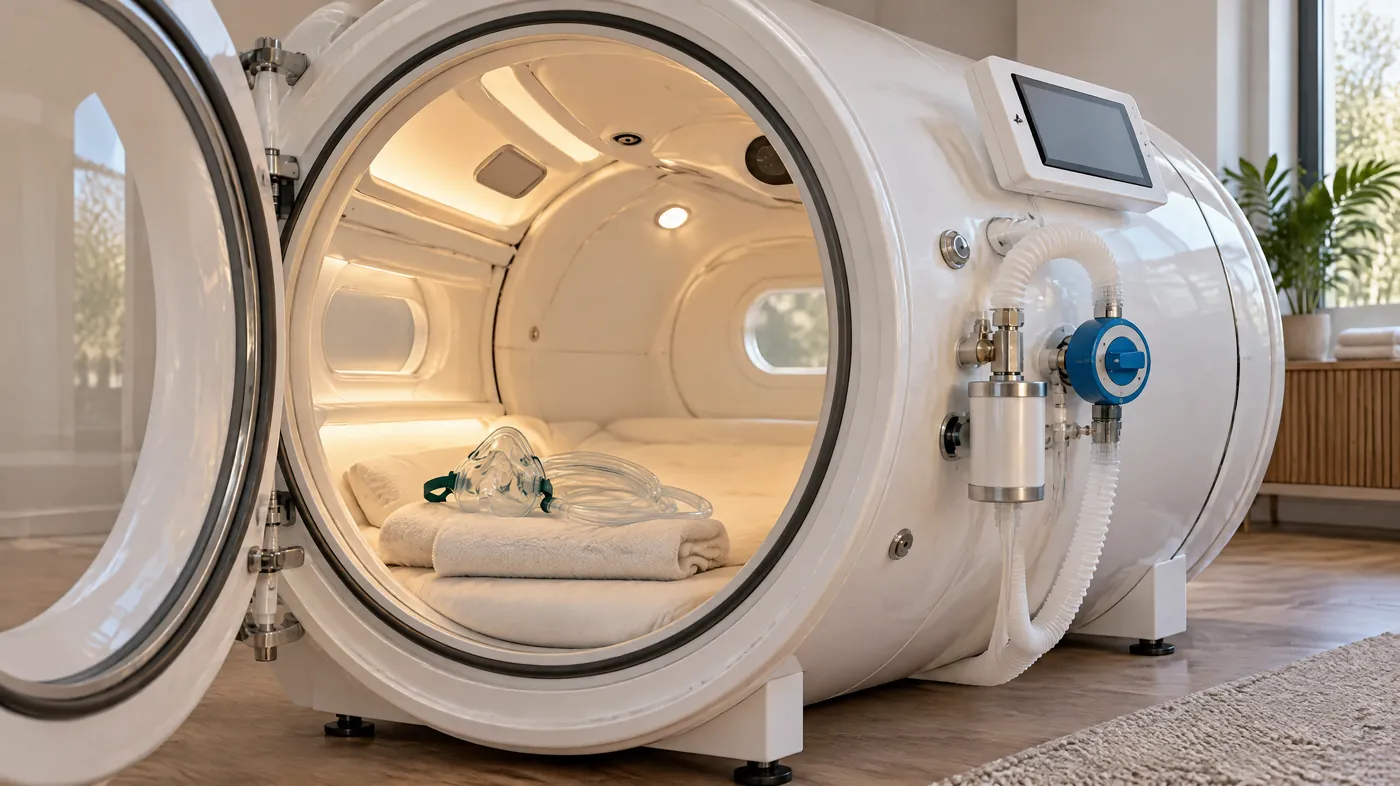
What extra pressure costs you in the room
Pressure is not only a line on the spec sheet. It sets the weight, the floor space and the session itself.
- Weight. The Dive-series 510(k) lists the Grand Dive bag at 32 pounds and its compressor at 24. Macy-Pan lists its HP2202-90 hard-shell at 200 kg for the cabin plus 80 kg for the machine cabinet. OxyHealth gives 1,250 pounds for the steel Fortius 420. Ask about doorway widths, stairs and floor loading before the truck arrives.
- Footprint and power. Superhuman gives its seated T2 a 6 ft 10 in by 5 ft 5 in footprint and says it runs on 110 V or 240 V; most hard-shell systems add a compressor and concentrator cabinet beside the vessel, which also brings heat and fan noise into the room.
- The session. Every jump in pressure means more compression to equalise through. Mayo Clinic lists ear pain, middle-ear injury including eardrum rupture, sinus pain, a short-term dip in lung function and, rarely, seizures from too much oxygen as the risks of hyperbaric treatment, and notes that the risk of complications rises with longer and repeated sessions. Clinical sessions there typically run 1.5 to 2 hours, and non-healing wounds may take 40 sessions or more.
More pressure is not automatically more benefit
The marketing logic of “higher number, better chamber” runs into two problems. First, the evidence base for wellness uses is thin at every pressure, and the regulators say so. Second, oxygen behaves like a dose. A small 2023 study put 14 healthy volunteers on pure oxygen for an hour at either 1.4 ATA or 2.5 ATA. Reactive oxygen species rose by a similar amount at both pressures, while some inflammation and immune markers rose more after 2.5 ATA, which the authors read as a dose-dependent response. Pressure changes the biology; it is not a volume knob for benefit. Higher pressure also means more stress on ears and sinuses during compression, longer decompression and a heavier, costlier vessel. As we noted in our earlier look at the recovery evidence for hyperbaric chambers, the trials that found effects mostly used clinical pressures and repeated sessions.
Questions to ask before you pay for pressure
Before the deposit, get written answers to these:
- What is the operating pressure, and what is the maximum? A chamber “up to 2.0 ATA” may be sold or configured to run lower. Ask what pressure the sessions will actually use.
- What exactly is the oxygen source, at what purity and flow? A pressure rating with room air is a different product from the same rating with 93% oxygen by mask.
- Is the cabin filled with air or oxygen? If oxygen, ask what fire controls, staff training and grounding the manufacturer requires.
- Which FDA clearance covers this model, and for what indication? Ask for the 510(k) number and read the indication line yourself on the FDA database.
- Is the vessel built and stamped to ASME PVHO-1? The UHMS notes that the standard applies to any chamber enclosing a person above 2 psig, which covers every model in the table.
- Does the room need preparation? Weight, floor loading, electrical circuit, ventilation and climate all matter for hard-shell units.
- Who services it, and what does the warranty cover? Compressors, concentrators and seals wear. Find out who replaces them and how fast.
- Has a clinician signed off on you using it? Both the soft-chamber files and the clinical literature assume a prescription. Ear, sinus, lung and seizure history are the usual reasons for caution.
Frequently asked questions
Do you need a prescription to buy a hyperbaric chamber? The FDA files assume one. The Dive-series soft chambers are cleared for acute altitude sickness “as prescribed by or under the direction of a physician,” Newtowne says its mild chambers require a prescription for human medical use, and OxyHealth states that the Fortius 420 requires one to operate. How strictly sellers check varies, which is a separate question from what the device is cleared for.
Does 2.0 ATA mean twice as much oxygen? Only if the oxygen fraction stays the same. Doubling pressure doubles the partial pressure of whatever you are breathing: air at 2.0 ATA gives about 0.42, while near-pure oxygen by mask at 2.0 ATA gives about 1.9. The gas source moves the number far more than the last half-atmosphere does.
Can a soft-shell chamber reach 2.0 ATA? Conventional soft chambers sit at 1.3 to 1.5 ATA, and the FDA-cleared soft chambers we found are 1.3 ATA. At least one maker, RL Health, sells a reinforced soft-shell model rated up to 2.0 ATA. Treat any such claim model by model and ask for the clearance and pressure-vessel certification.
What depth is 1.5 ATA? About 16 feet (5 metres) of seawater. 1.3 ATA is roughly 10 feet, 2.0 ATA about 33 feet.
Is 1.3 ATA enough for home use? That depends on what “enough” means. For its cleared indication, acute altitude sickness, 1.3 ATA is the design pressure. For anything on the UHMS list of approved hyperbaric indications, it is not: those require near-100% oxygen at 2 ATA or more, and the UHMS says it knows of no reliable evidence that compression below 1.4 ATA has a therapeutic effect.
Who needs a 3.0 ATA chamber? Hospitals and accredited clinical programmes. The Sechrist and Perry monoplace units are built to reach 3 ATA, and Sechrist’s 510(k) describes the oxygen dose being set by selecting the chamber pressure, a clinical decision made under supervision. A home buyer has no use for that ceiling.
The pressure number is real and it does change what a chamber can deliver. But on its own it tells you very little. Read it next to the oxygen source, the clearance on file and the build standard, and the price gap between a 1.3 ATA bag and a 2.0 ATA vessel starts to make sense, or stops making sense, depending on what you actually intend to use it for.
None of this is a recommendation to buy or use a hyperbaric chamber. Anyone considering hyperbaric exposure for a health reason should start with a healthcare professional; our medical disclaimer sets out what this site does and does not do.